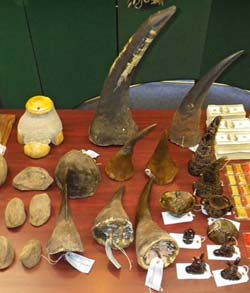


Wildlife trafficking - the illegal trade in wildlife and wildlife products - is a soaring black market worth an estimated $10 billion a year. Learn More >>
The Department of State, in partnership with non-profit organization
WildAid, has produced three televsion public service announcements to combat wildlife trafficking, featuring actor Harrison Ford. More than 30 U.S. embassies in all regions of the world showcased the PSAs in a global launch beginning June 5, World Environment Day. The ads continue to be broadcast globally.
Watch the videos >>
Celebrities Join World Bank in Saving Tigers
More than a Million Birds Killed in Cyprus
Chinese Parks 'Sell Tiger Wine'
July 8, 2008 - Leaders from the G-8 countries agreed today to reduce threats from the illegal trade in wildlife, saying "We endorse the Kobe Call for Action for Biodiversity and reiterate our commitment to increase our efforts to reduce the rate of biodiversity loss significantly in order to achieve the globally agreed 2010 Biodiversity Target, including by reducing threats from the illicit trade in wildlife."
>> See the full Environment and Climate Change Declaration
June 10, 2008 - State Department
Use the controls below to play the video
Mar 1, 2008 (Newsweek - Mar 10, 2008 issue) - The marauders galloped into Zakouma National Park in Chad, the last refuge of that country's once thriving elephant population. Rather than bother with the few remaining elephants, the attackers last May were after the 1.5 tons of ivory—worth as much as $1.3 million—that Chadian officials had seized from poachers over the years and stored in a strongroom at park headquarters. Neither the audacity of the attack nor its brutality—the raiders killed three park rangers—shocked wildlife officials: some 100 rangers, outgunned and outmanned, are killed every year defending Africa's wildlife. Rather, the shock was the identity of the attackers.
In an ominous sign of how the killing of endangered animals has evolved from a crime committed by small bands of unorganized, mostly poor operators, these attackers were Janjaweed, the militia that has carried out genocidal attacks in Darfur. Lured by easy money, the Janjaweed have expanded their killing fields to endangered species. In the past two years, they have butchered hundreds of elephants around Zakouma, say Chadian authorities, carrying the tusks back to Sudan, where they are secreted on ships bound mostly for Asia—or traded for weapons.
PHOTO GALLERY:
Grim Managerie >>
Kathmandu, Nepal, Feb 6, 2008 – All eight South Asian nations have agreed to step up cooperation in addressing wildlife trade problems in the area.
The region, home to such rare and prized species as tigers, Asiatic lions, snow leopards, Asian elephants and one-horned rhinoceroses, is recognized as one of the prime targets of international organized wildlife crime networks.
Wildlife trade officials from Afghanistan, Bangladesh, Bhutan, India, the Maldives, Nepal, Pakistan and Sri Lanka met in Kathmandu last week and defined a series of joint actions under the new South Asia Wildlife Trade Initiative (SAWTI).